


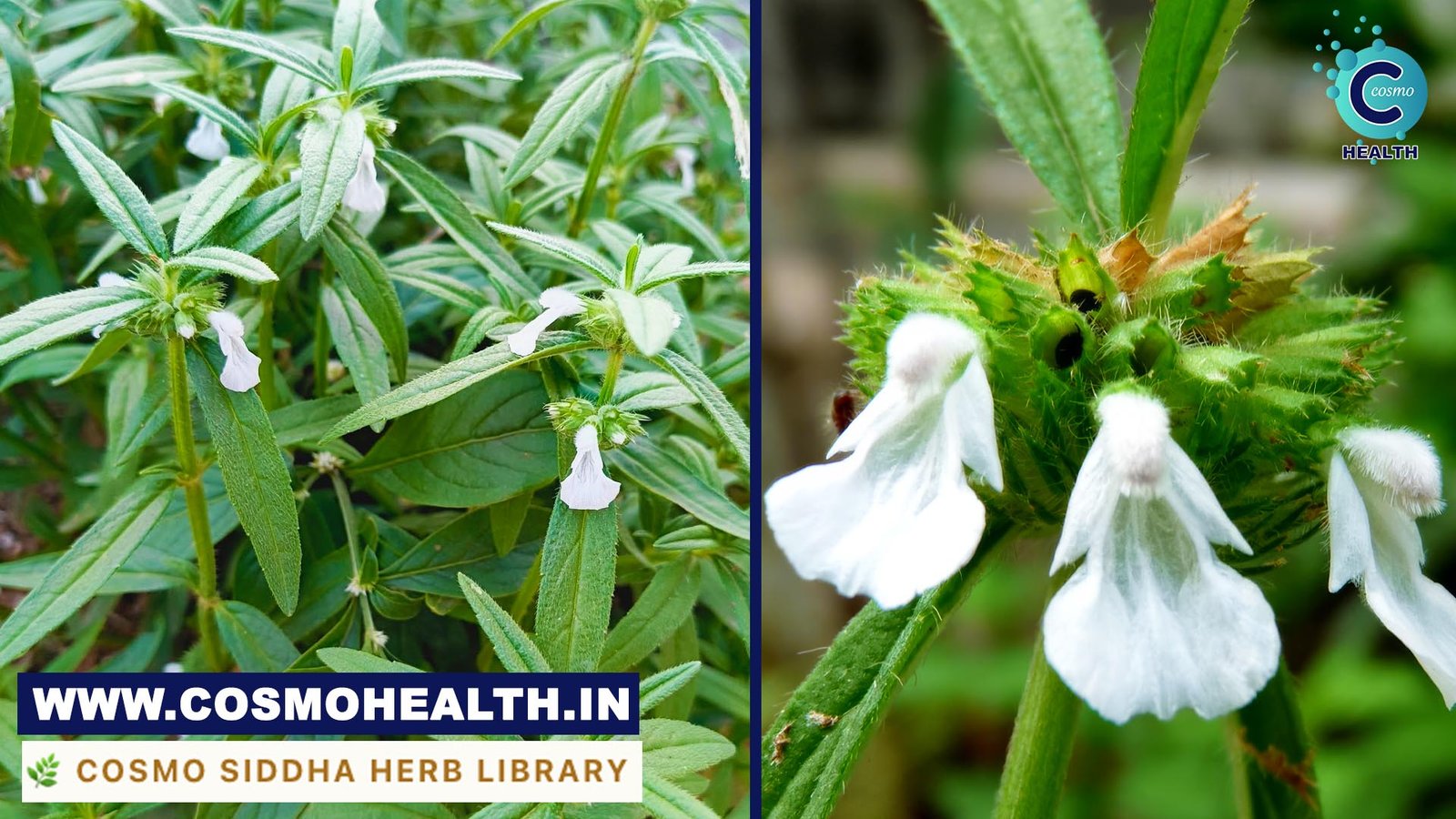
Thumbai, a revered Siddha herb, offers cooling properties and remedies for various ailments, known for its distinct white flowers.
🌿 COSMO SIDDHA HERB LIBRARY
Thumbai
The pure white bloom for a healthy life.
Thumbai, scientifically known as Leucas aspera, is a common herbaceous plant widely used in Siddha and traditional medicine. Revered for its white flowers and therapeutic properties, it is a significant cooling and anti-inflammatory agent.
🌱 What is Thumbai (Leucas aspera)?
This article provides comprehensive information on Thumbai (Leucas aspera) from a Siddha and botanical perspective.
🌿 Thumbai
Common Leucas (Leucas aspera (Willd.) Link)
How to identify Thumbai
👁️ Distinctive Features
Leaves: Opposite, simple, sessile or sub-sessile, lanceolate or linear-lanceolate, margins entire or crenate, typically hairy.
Stem: Erect, quadrangular, often branched, hairy, pale green to purplish.
Fruit/Flower: Schizocarpic, splitting into four obovoid nutlets, enclosed within the persistent calyx.
🌱 Geographical Distribution
Thumbai is a ubiquitous plant found across diverse landscapes, thriving in tropical and subtropical regions.
- Indian subcontinent
- Southeast Asia
- Parts of Africa
⚠️ Potential Look-alikes
Can be confused with other Leucas species or similar white-flowered weeds. Thumbai (L. aspera) is distinguished by its dense, terminal whorls of white flowers, often subtended by leaf-like bracts, and characteristic quadrangular stem. Other Leucas species may have different flower arrangements or leaf shapes.
Thumbai in Siddha Medicine
Traditional Reference Traditional Reference 🟤
In Siddha medicine, Thumbai is highly valued for its cooling (சீதவீரியம்) and anti-inflammatory properties. It is extensively used to treat respiratory conditions, fever, headaches, skin ailments, and as an antidote for snake bites and scorpion stings. It is believed to balance Pitta and Kapha doshas.
📖 Classical Siddha Texts
Meaning: If you use Thumbai flower daily, you will become as clear (pure, healthy) as the Thumbai flower.
Associated Siddhar
Agathiyar
Agathiyar is revered as the father of Siddha medicine, whose teachings encompass various herbs and their therapeutic applications, including the principles behind using plants like Thumbai for holistic healing.
Therapeutic Uses and Effects
🌿 Traditional Siddha Uses
Traditional Use 🟤- Fever and Cold: Leaf juice or decoction is used to reduce fever, especially in children, and relieve cold symptoms and cough.
- Headaches and Sinusitis: Crushed leaves or flower paste applied externally on the forehead or inhaled for relief from headaches and sinusitis.
- Skin Ailments: Paste of leaves applied to treat insect bites, skin infections, scabies, and fungal infections due to its antiseptic properties.
- Asthma and Respiratory Issues: Decoction or juice is consumed for respiratory conditions like asthma, bronchitis, and cough with phlegm.
- Digestive Aid: Used in some formulations to improve digestion and alleviate stomach pain.
- Antidote: Traditionally used as an antidote for snake bites and scorpion stings (external application and internal consumption, though this needs extreme caution).
🧬 Modern Scientific Research
Research Evidence 🔵Contemporary research is exploring the pharmacological properties of Leucas aspera, validating some of its traditional uses.
- Anti-inflammatory and Analgesic: Studies have shown that extracts of Leucas aspera possess significant anti-inflammatory and analgesic activities, supporting its use in pain and inflammatory conditions.
- Antimicrobial Activity: Research indicates its efficacy against various bacteria and fungi, validating its traditional use for skin infections and wound healing.
- Antioxidant Potential: Phytochemical analysis reveals the presence of flavonoids and phenolic compounds, contributing to its antioxidant properties.
- Antipyretic Effects: Studies have confirmed its fever-reducing properties, aligning with its traditional application in fevers.
⚠️ Safety & Warnings
Remember, 'natural' does not always equate to 'safe.' All herbal remedies should be used with caution and informed guidance.
Who should be careful
- Pregnant and breastfeeding women should avoid use unless directed by a healthcare professional.
- Individuals with known allergies to plants in the Lamiaceae family should exercise caution.
- Children should only be given under strict medical supervision.
- Those with underlying health conditions or on medication should consult a doctor before use.
Side Effects
While generally considered safe in traditional doses, excessive consumption may lead to stomach upset or allergic reactions in sensitive individuals. Long-term effects are not fully studied, hence intermittent use under guidance is advisable.
🌿 Quick Summary
📚 Sources
- Siddha Vaidya Thirattu
- Indian Pharmacopoeia (Herbal Monographs)
- Review articles on Leucas aspera pharmacology
- Traditional Siddha practitioners' knowledge