


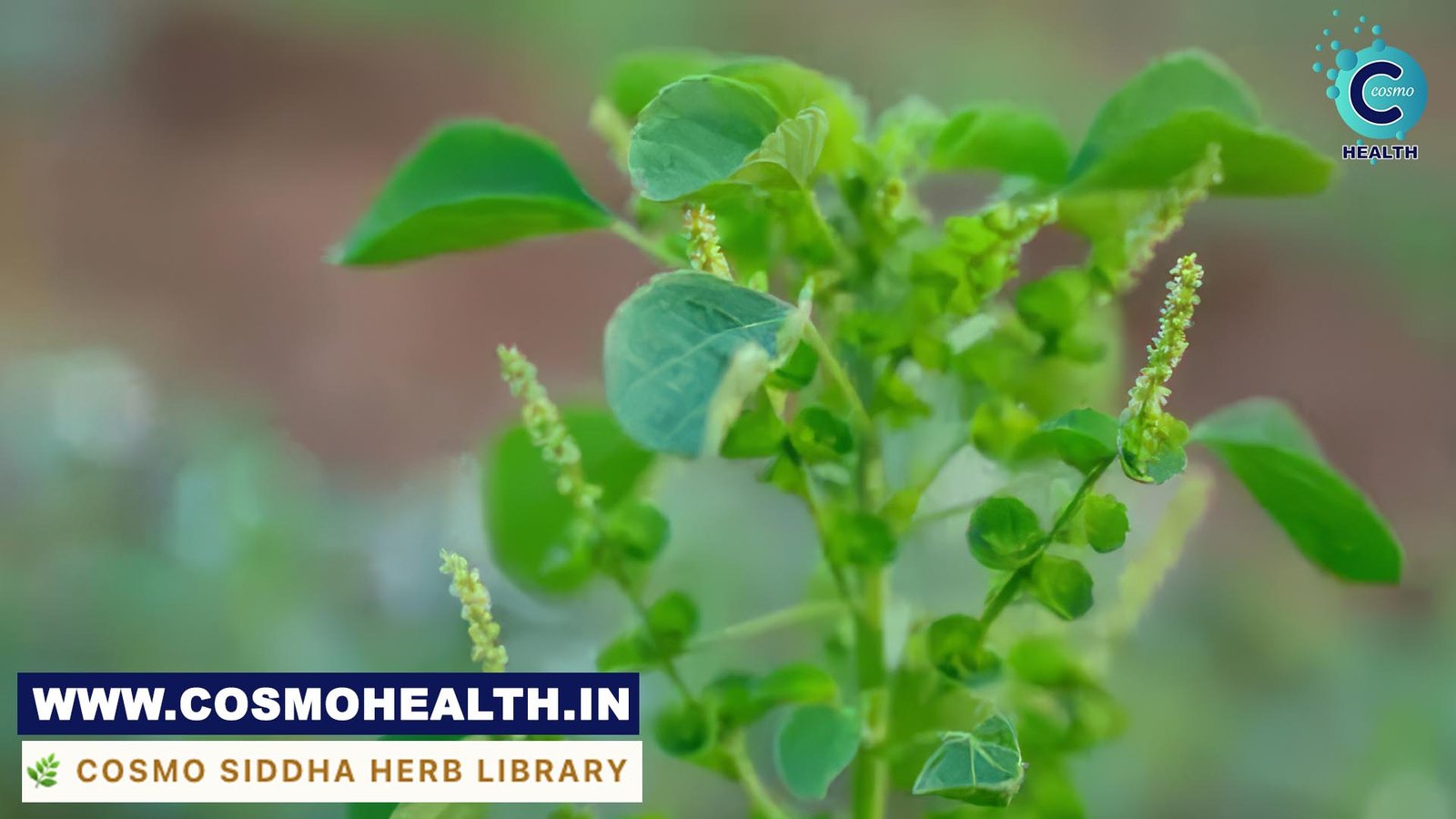
Indian Nettle (Acalypha indica), known as Kuppaimeni, is a vital Siddha herb for respiratory health, skin issues, and parasitic conditions.
🌿 COSMO SIDDHA HERB LIBRARY
Indian Nettle
The potent herb for respiratory and skin ailments, revered in Siddha medicine.
Indian Nettle, or Kuppaimeni (குப்பைமேனி) in Tamil, is a common herbaceous plant widely recognized in traditional Siddha medicine. Known for its distinct medicinal properties, it is particularly valued for its efficacy in treating respiratory ailments, skin conditions, and various internal parasitic infections, balancing Kapha and Vata doshas.
🌱 What is Indian Nettle (Kuppaimeni)?
Verify your herb with these detailed botanical descriptions and traditional uses.
🌿 Indian Nettle
Indian Nettle (Acalypha indica)
How to identify Indian Nettle
👁️ Distinctive Appearance
Leaves: Leaves are alternate, ovate to rhombic-ovate, 2-6 cm long, with serrated margins and an acute apex. They are typically light green with prominent veins.
Stem: Stems are erect or ascending, branched, cylindrical, often purplish at the base, and slightly hairy.
Fruit/Flower: Fruits are small, three-lobed capsules, approximately 2mm in diameter, containing tiny, dark seeds. They develop within the axillary spikes.
🌱 Where does Indian Nettle grow?
Indian Nettle is a widespread weed found across tropical and subtropical regions, thriving in disturbed soils and neglected areas.
- India
- Sri Lanka
- Southeast Asia
- Africa
- Australia
⚠️ Do not confuse with
While many *Acalypha* species exist, *Acalypha indica* is distinct. Do not confuse with other plants sharing common 'nettle' names, which may belong to different families (e.g., Urticaceae). Key identifiers for *A. indica* are its specific ovate-rhombic leaf shape, serrated margins, and the characteristic spicate inflorescence with female flowers subtended by large, cup-like bracts.
Indian Nettle in Siddha Medicine
Traditional Reference Traditional Reference 🟤
Known as 'Kuppaimeni' (குப்பைமேனி) in Tamil, it is a cornerstone herb in Siddha for its anti-inflammatory, anthelmintic, expectorant, and analgesic properties. It effectively balances Kapha and Vata doshas, making it versatile for various ailments.
📖 Siddha Texts and Formulations
Meaning: Kuppaimeni, the herb with hair-like qualities (referring to its fine hairs or benefits for hair health), is a wild plant born amidst refuse. It removes both chronic (old) and acute ailments, and dispels the afflictions associated with disease and suffering.
Associated Siddhar
Agathiyar
Agathiyar, the foremost Siddhar, is traditionally credited with extensive knowledge of herbal medicine, including the properties and uses of common plants like Kuppaimeni. His teachings and the texts attributed to him or his lineage form a significant part of Siddha pharmacology.
Uses and Therapeutic Effects
🌿 Traditional Uses
Traditional Use 🟤- Respiratory Ailments: Effective for coughs, colds, asthma, and bronchitis due to its expectorant properties. Leaf juice is commonly administered, often mixed with honey, to relieve phlegm and ease breathing.
- Skin Disorders: Used topically as a paste or poultice for eczema, scabies, ringworm, acne, wounds, and insect bites. Its anti-inflammatory, antimicrobial, and wound-healing actions are highly beneficial for skin health.
- Parasitic Infections: An effective anthelmintic, it is traditionally used to expel intestinal worms (especially in children) and treat other parasitic conditions internally and externally.
- Digestive Health: Used to relieve constipation and improve digestion. The root decoction is sometimes used as a mild laxative, and the leaves can aid in detoxifying the gut.
- Pain and Inflammation: Applied externally as a warm poultice or oil infusion for joint pains, arthritis, muscular aches, and swellings due to its analgesic and anti-inflammatory effects.
- Fever: A decoction of the whole plant is used to reduce fever, often combined with other febrifuge herbs.
🧬 Modern Research & Evidence
Research Evidence 🔵Contemporary scientific studies are increasingly exploring and validating many of the traditional uses of *Acalypha indica*, identifying its rich phytochemical constituents and diverse pharmacological activities.
- Antimicrobial Activity: Studies have shown extracts of *Acalypha indica* to possess significant antibacterial, antifungal, and antiviral properties against a range of pathogens, supporting its traditional use in skin infections and wound healing.
- Anti-inflammatory & Analgesic: Pharmacological research confirms its anti-inflammatory and pain-relieving effects, validating its traditional application for various inflammatory conditions and muscular pains.
- Anthelmintic Potential: In-vitro and in-vivo studies support its traditional use against intestinal parasites, demonstrating efficacy against certain helminthes, particularly effective in pediatric cases.
- Antioxidant Activity: The plant contains various phenolic compounds, flavonoids, and other phytochemicals, contributing to its significant antioxidant capacity, which helps combat oxidative stress and cellular damage.
- Hepatoprotective Activity: Some studies suggest a potential role in liver protection, exhibiting hepatoprotective effects against chemically induced liver damage.
⚠️ Safety & Warnings
Remember, 'natural' does not always mean 'safe'. Medicinal herbs are potent and require careful use and professional guidance.
Who should be careful
- Pregnant and breastfeeding women should strictly avoid internal use without explicit medical supervision.
- Individuals with known allergies to plants in the Euphorbiaceae family should exercise extreme caution.
- Internal use should be moderated and for short durations, as high doses may cause gastrointestinal discomfort.
- Always consult a qualified Siddha practitioner or healthcare provider before use, especially if on other medications or having pre-existing health conditions.
Possible Side Effects
Generally considered safe when used appropriately and in recommended dosages. However, excessive internal consumption may lead to nausea, vomiting, or diarrhea. Topical application may cause mild skin irritation or allergic reactions in sensitive individuals. Always perform a patch test before widespread topical application.
🌿 Quick Summary
📚 Sources
- Siddha Vaidhya Thirattu (Traditional Siddha Text)
- API (Ayurvedic Pharmacopoeia of India, Part I, Vol. V)
- The Wealth of India: Raw Materials (CSIR, India)
- Journal of Ethnopharmacology, various research articles on Acalypha indica
- Review articles on traditional medicinal plants of India and phytochemistry